Statistical news focuses on the latest figures and trends in Danmarks Nationalbank’s statistics. Statistical news is targeted at people who want quick insight into current financial data.
The financial sector’s climate footprint increased slightly in 2025
By the end of 2025, the Danish financial sector had invested around kr. 2,200 billion in listed non-financial companies. Through these investments, it financed total greenhouse gas emissions of 11.3 million tonnes in 2025, a slight increase on 2024. The increase in financed emissions was driven primarily by a larger share of investments in companies in the transport and materials sectors. Financed emissions are concentrated on a small number of listed equities and bonds, meaning that even minor shifts in portfolio composition can have a significant impact. Indeed, around 6 per cent of the sector’s investments account for half of its financed emissions. Overall, financed emissions have declined since 2018, partly reflecting divestments from carbon-intensive companies and lower emissions among investee companies. The statistics currently cover investments in listed companies only, and coverage will be expanded over time as additional data become available, see information box below.
The financial sector financed 11.3 million tonnes of CO₂e in 2025
Note:
Financed emissions are measured at year-end (i.e. fourth quarter) and calculated as the financial sector’s financed scope 1 and 2 emissions from investments in listed non-financial corporations (S.11). Financed emissions refer to the emissions attributable to an investor’s holdings in equities and bonds: for example, if an investor finances 5 per cent of a company, the investor is considered to finance 5 per cent of that company’s emissions. *2025 figures are preliminary, see sources and methodology (link). Find chart data here (link).
Source:
Danmarks Nationalbank and MSCI
What is included in the climate-related indicators for the financial sector?
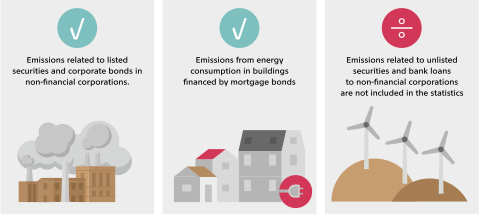
Note: The climate-related indicators cover insurance and pension companies, investment funds, as well as banks and mortgage credit institutions, while holding companies and other credit institutions are not included, see sources and methods.
The climate-related indicators show the financial sector's climate footprint in terms of financed emissions from investments in listed companies. The data covers the majority of the sector's investments, with some exceptions. For example, financing of greenhouse gas emissions from bank loans is not included. The same applies to emissions from unlisted equities and bonds, which are also not included. The central bank is working to fully illuminate the financial sector's financing of greenhouse gas emissions. The coverage will gradually be expanded as relevant data becomes available.
Data can be found in the statistics database, and you can read more about the accounting method and uncertainties in sources and methods on the central bank's website (link).