Analyses focus on current issues of particular relevance to Danmarks Nationalbank’s objectives. The analyses may also contain Danmarks Nationalbank’s recommendations. They include our projections for the Danish economy and our assessment of financial stability. Analyses are targeted at people with a broad interest in economic and financial matters.
Interest rate increases and high risk appetite
Since the war in the Middle East broke out in February, the European Central Bank, ECB, and the Federal Reserve in the US, Fed, have tightened monetary policy, and market expectations for policy rates in both the euro area and the US have risen. Over the same period, the krone has gradually weakened against the euro, and Danmarks Nationalbank made minor interventions in the foreign exchange market in June and August. The bank followed the ECB’s policy rate hikes of 25 basis points in June and September. The monetary policy spread is therefore unchanged at -40 basis points. Danmarks Nationalbank assesses that monetary policy and financial conditions are currently broadly neutral for the Danish economy.
Key messages
Main chart
Danish interest rates have risen since March 2026
Note:
The monetary policy rate is the current account rate. Level changes in the 30-year convertible series reflect coupon changes. The latest data point is 16 September 2026.
Source:
Danmarks Nationalbank, LSEG Workspace and Nordea Analytics.
Why is this important?
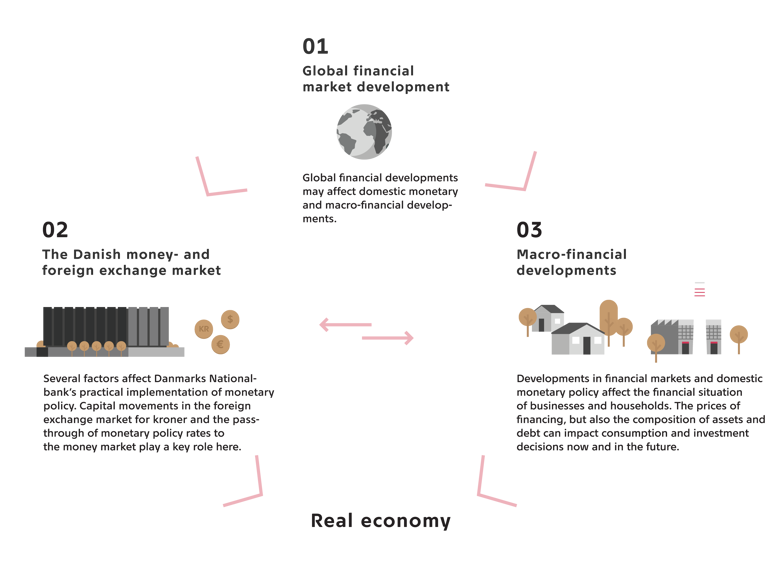
Denmark's fixed exchange rate policy means that monetary policy is designed to ensure a stable exchange rate for the krone against the euro. The fixed exchange rate policy means that, as a general rule, Danmarks Nationalbank follows the ECB's interest rate decisions. Therefore, the monetary policy of the euro area has a bearing on financial and economic developments in Denmark. So do global financial developments, as Denmark is a small open economy closely integrated into the international financial system. Both are analysed in chapter 1. Global financial developments may also affect the demand for kroner and consequently Danmarks Nationalbank’s execution of the fixed exchange rate policy. This is one of the elements touched upon in the second chapter. An important element in the third chapter of the analysis is the assessment of how the fixed exchange rate policy, in conjunction with global financial developments, affects macro-financial conditions in Denmark. These conditions are important for Danmarks Nationalbank’s assessment of current and expected developments in the Danish economy.
The analysis is published twice a year.